EAA for Muscle Recovery: The Science of DOMS, MPS & Amino Timing
Most “EAA for recovery” content stops at “amino acids help repair muscle,” without getting into the actual mechanics of what recovery involves or how amino acid timing plays into it. This piece goes a level deeper — into muscle soreness itself, how muscle protein synthesis actually responds to amino acid availability, and how EAA supplementation compares to whey protein specifically for recovery purposes.
Quick answer: Muscle recovery involves two overlapping processes — reducing exercise-induced soreness (DOMS) and rebuilding muscle protein through muscle protein synthesis (MPS). EAAs support the second process directly, since MPS depends on having all nine essential amino acids available at once, not just protein in general. EAAs act faster than whey because they don’t need to be digested and broken down first, making them useful when speed of amino acid availability matters — though whey still provides a broader nutritional package for total daily needs.
What “Muscle Recovery” Actually Involves
Recovery isn’t one single process — it’s really two things happening together. First, there’s delayed-onset muscle soreness (DOMS), the stiffness and tenderness that shows up 24–72 hours after unfamiliar or intense training, caused by microscopic damage to muscle fibers. Second, there’s muscle protein synthesis (MPS) — the process of rebuilding and adapting that damaged tissue, which is what actually drives strength and muscle growth over time. Reducing soreness and rebuilding tissue aren’t the same thing, and it’s worth understanding both before looking at where EAAs fit.
The Muscle Protein Synthesis Trigger
MPS isn’t just about how much total protein you eat — it depends specifically on having all nine essential amino acids available together in your bloodstream at sufficient levels. If even one essential amino acid is missing or too low, the process can’t run at full capacity, since the body can’t substitute a missing essential amino acid the way it can with non-essential ones (which it can synthesize on its own). This is the core reason EAA supplementation is framed around “completeness” — it’s specifically designed to supply all nine at once, not just a partial amino acid profile.
Leucine’s Specific Role
Among the nine essential amino acids, leucine gets particular attention because it acts as a kind of trigger for MPS — research points to it activating a key cellular pathway (mTOR) that kicks the muscle-building process into gear. This is part of why EAA formulas are often evaluated not just on total amino acid content, but specifically on how much leucine they provide relative to the others.
Does EAA Reduce DOMS Directly?
This is a common point of confusion. EAAs support the rebuilding process (MPS) more directly than they numb or prevent soreness itself. Some research suggests amino acid supplementation, including BCAAs and EAAs, may be associated with modestly reduced perceived soreness in certain contexts — but the evidence here is less conclusive than the MPS research, and EAAs shouldn’t be framed as a soreness “cure.” The more accurate framing is that supporting MPS well may help you recover functionally faster, which can indirectly translate into feeling more ready for your next session.
EAA vs Whey Protein for Recovery: What’s Actually Different
This is where things often get oversimplified. Whey protein contains essential amino acids too — it’s a complete protein. The practical difference for recovery comes down to two things:
Speed of availability. EAAs in free-form (as found in EAA+ Energy) don’t need to be broken down through digestion first — they’re already in the form your body uses directly, so they reach your bloodstream faster than whey, which has to be digested and broken down into amino acids before it can be used the same way.
Completeness of the package. Whey protein delivers its aminos along with a broader nutritional profile — total protein content, and depending on the formula, additional micronutrients. EAAs are a more targeted delivery of just the nine essential aminos, without that broader package.
In practice, this means EAAs are particularly useful in situations where speed matters — during or immediately around training — while whey remains a strong choice for total daily protein needs. Many people use both: EAAs around training sessions, whey protein as part of overall daily intake. They’re not competing products so much as suited to different jobs.
EAA vs Whey for Recovery at a Glance
| EAA (Free-Form) | Does Intra-Workout Sipping Make Sense? | |
| Requires digestion first | No | Yes |
| Speed of amino acid availability | Faster | Slower (digestion-dependent) |
| Provides all 9 essential amino acids | Yes | Yes |
| Broader nutritional profile | No — targeted amino delivery | Yes — full protein package |
| Best suited for | Around training, when speed matters | Total daily protein needs |
Putting It Together: A Practical Recovery Framework
For meaningful recovery support, three things matter more than any single supplement: getting enough total daily protein (from food and/or protein supplements), having your essential amino acids available around your training window specifically, and allowing adequate rest between sessions targeting the same muscle groups. EAA supplementation addresses the second piece directly — it’s a tool for making sure your amino acid availability lines up with when your body needs it most, not a replacement for total protein intake or rest.
About MuscleTech™ EAA+ Energy
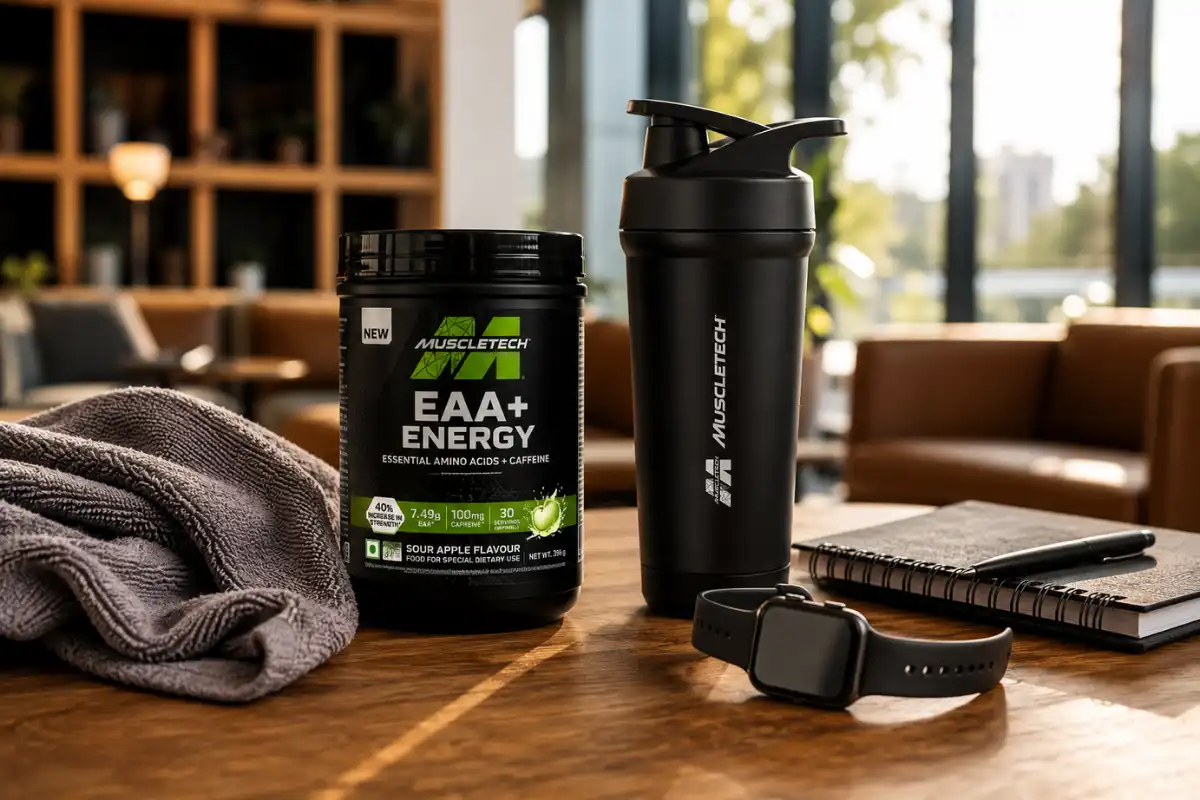
Each serving of MuscleTech™ EAA+ Energy provides 7.49g of essential amino acids, including a leucine-forward ratio (3g leucine) and 4.5g of BCAAs, delivered in free-form for fast availability. It’s combined with an electrolyte blend to support hydration and 100mg of caffeine for focus, making it suited to use around training sessions specifically — where the speed advantage of free-form aminos matters most.
Frequently Asked Questions (FAQs)
Do EAAs directly reduce muscle soreness (DOMS)?
Not directly in a strong, well-established way — the research on amino acids and soreness is less conclusive than the research on muscle protein synthesis. EAAs primarily support the rebuilding process, which may indirectly help you feel more recovered.
Why does leucine matter more than other essential amino acids for recovery?
Leucine is thought to act as a trigger for muscle protein synthesis by activating a specific cellular pathway (mTOR), which is why EAA formulas are often evaluated on leucine content specifically, not just total amino acid volume.
Is EAA better than whey protein for recovery?
Neither is strictly “better” — they serve different roles. EAAs are absorbed faster since they skip digestion, making them useful around training specifically. Whey provides a broader nutritional package better suited to total daily protein needs.
Can I take EAA and whey protein together?
Yes. Many people use EAAs around their training window for fast amino acid availability and whey protein as part of their broader daily protein intake — they’re complementary rather than interchangeable.
How much of EAA+ Energy’s formula is leucine?
Each serving provides 3g of leucine as part of its 7.49g total essential amino acid content, alongside 4.5g of BCAAs.
Does muscle recovery depend only on amino acids?
No. Total daily protein intake and adequate rest between training sessions targeting the same muscles both play a significant role — amino acid timing supports recovery but doesn’t replace those fundamentals.